Gemstone lovers know that there are many different cuts for gemstones. Different gemstones have different physical structures, internal compositions, and appearances, so jewelry designers need to create different cuts for different gemstones to ensure that they get the most out of the gemstones and show off their charm and elegance. So, what are the most common gemstone cuts? Which cuts are suitable for different gemstones? What are the differences between them? With these questions in mind, let’s find out today!
I. Diamonds
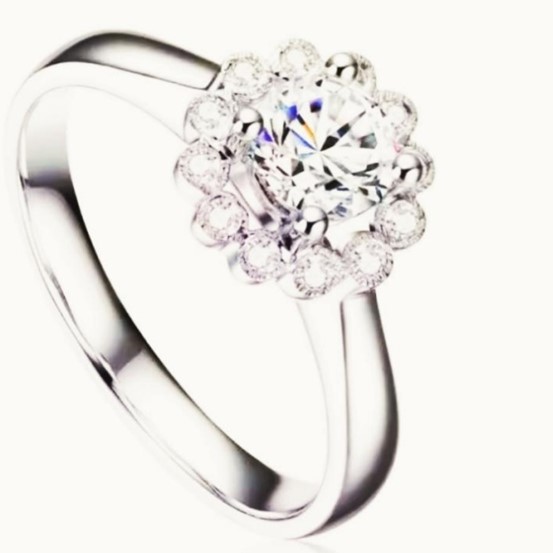
Diamonds are carved with eight hearts and eight arrows, nine hearts and one flower, ten hearts and ten arrows and so on. Although they have different names, the origin of their names is very similar. Let’s take the most heard of Eight Hearts and Eight Arrows as an example. The reason it is called Eight Hearts and Eight Arrows is because the gemstone under this cutting process can be seen as eight arrows of similar size and symmetry when viewed from the upper facet. On the underside of the stone, you can see eight full and symmetrical hearts. However, there are good and bad Eight Hearts and Eight Arrows, good Eight Hearts, and Eight Arrows, its eight hearts and eight arrows are very full and symmetrical. Of course, we ordinary people with the naked eye is not obvious. Therefore, professional jewelry craftsmen will use some professional tools to check the quality of gemstone cutting, such as a stereo microscope with a large aperture objective lens and LCD display can help jewelry craftsmen to easily observe the quality of the cutting process. After all, jewelry is an extremely delicate matter, and the slightest mistake can make a huge difference!
So why is it that most diamonds are engraved in this way? We all know that diamonds are commonly used to witness love, while the eight hearts represent encounter, love, hint, dream, first kiss, lingering, tacit understanding, and alliance. These beautiful meanings make diamonds the first choice for wedding rings. Nine hearts, one flower and ten hearts and ten arrows are more complex and have more meanings. Because of this, these techniques require a higher level of competence from the jeweler and are naturally more expensive.
II. Crystal
As there are many types of crystals, their internal structure varies greatly, and the crystal engraving process can transform the disadvantages of crystals into advantages. Crystals are common minerals in nature, including natural crystals, amethysts, yellow crystals, and smoky crystals. Crystal carving methods include relief, translucent, openwork, and line carving, and the following is a brief introduction to them.
Firstly, relief carving. As the name suggests, it is the removal of excess material to give the surface of the crystal a raised shape. But crystal carving and ordinary round carving is different, round carving can be used to 360 degrees viewing, while the effective viewing part of the crystal relief carving is only within 60 degrees to 80 degrees, has certain limitations.
Secondly, there is perspective carving, which is also called openwork carving, and is divided into two types: flat perspective carving and three-dimensional perspective carving. Translucent carving this carving method will have nothing to do with the work of the crystal part of all removed, to expand the scope of the visual space, making the work more three-dimensional.
Then there is openwork. Skeletonization is the process of carving a piece of raw material in a hollowed out manner, but with parts connected to each other. There are two types of openwork, deep openwork, and shallow openwork.
Lastly, line carving refers to the technique of using lines of different shades and thicknesses for modelling during the carving process. The characteristic of line carving is that it can make the carving works have the charm of painting and show a different style.
Crystal carving works of fine degree is no less than other gemstone carving, and even some of the works of the master craftsman more demanding, crystal carving is very much more detailed, this time it is necessary to carve the master carving machine with the original stone for the minutiae of the processing.
Ⅲ. Emeralds
It is important to note here that the emerald cut is named after the gemstone, emerald, and you can’t help but feel confused. What is the original reason for this? Here it is necessary to talk about the physical structure of the emerald and its properties. Although it is very hard, it is also very brittle. In addition, emeralds have their own internal cracks. The combination of many factors makes the cutting of emeralds very special, difficult, and challenging. Later, and because so many people studied it, the emerald-type cut shape got its name.

The cutting of emeralds is generally very much related to the shape and size of their raw stones, this is because most of the raw emeralds are cylindrical and hexagonal. To minimize the loss of raw material, emerald cutting tables are usually designed as squares or rectangles. The square or rectangular shape of the table gives the stone a mirrored effect, allowing the emerald to reflect more light and maximize its appeal, reflecting the stone’s translucent color and bringing out its own elegance, atmosphere, and class.
Although an emerald tabletop is simply a square or rectangle, it is carved through a variety of sophisticated calculation processes. There is quite a bit of expertise involved, including various mathematical, optical, and crystallographic expertise.
The simplicity and elegance of the emerald cut makes emeralds a good match for different materials and shapes, and it can even be said that emerald gemstones are a good match for any ring, and you can’t go wrong with them.