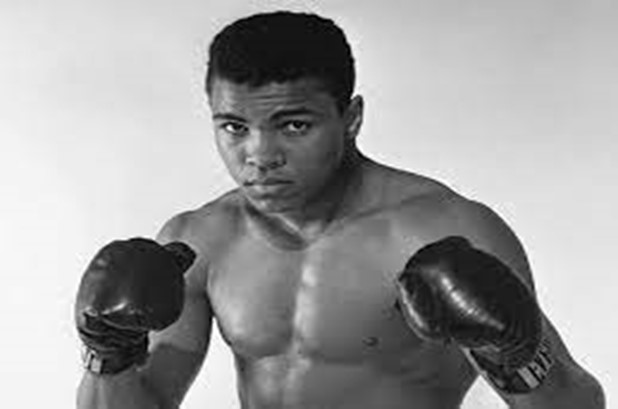
Born on January 17, 1942, in Louisville, Kentucky, as Cassius Marcellus Clay Jr., Muhammad Ali’s trajectory destined him for an iconic stature in sports history. His life’s narrative, woven with triumphs, hurdles, and a profound global influence, unveils an extraordinary odyssey from young pugilist to worldwide legend, defined by unmatched determination and bravery.
Early Years and Rising Stardom:
Ali’s love for boxing ignited at the tender age of 12, under the tutelage of Joe Martin, a boxing coach and police officer. Swiftly, Cassius Clay exhibited innate talent and indomitable spirit. His unwavering commitment secured him a spot in the 1960 Olympics in Rome, where he clinched the gold medal in the light heavyweight division.
The Birth of Muhammad Ali:
Embarking on his professional journey after conquering the Olympics, Clay found himself under the mentorship of Malcolm X and, later, Elijah Muhammad. Embracing Islam, he transformed into Muhammad Ali. This newfound faith enriched his persona profoundly, propelling him to prominence within boxing and broader societal landscapes.
The Thrilling Rivalry: Ali vs. Frazier:
A pivotal chapter in Ali’s saga unfolded through his enthralling rivalry with Joe Frazier. The world was captivated by their trio of monumental clashes, most notably the epic “Fight of the Century.”
- The “Fight of the Century” occurred at Madison Square Garden on March 8, 1971. The anticipation was unprecedented, drawing in a global audience eager to witness two undefeated champions collide. Frazier’s unyielding pressure and devastating left hooks against Ali’s agility and precision created a match of extraordinary intensity.
- Frazier’s victory in the first bout was a turning point. His relentless approach overcame Ali’s tactics, handing the champion his first professional defeat. It was a stark realization for Ali that he needed more than just charisma to triumph in the ring.
- Two rematches followed – “Super Fight II” in 1974 and the brutal “Thrilla in Manila” in 1975. Ali’s adaptability secured victories in both fights. The latter, in particular, pushed both men to their physical limits, with Ali emerging as the winner after a grueling battle.
- Ali and Frazier’s rivalry extended beyond boxing. It became a platform for debates on race, personality, and style. Ali’s brash persona clashed with Frazier’s humility, fueling discussions that resonated far beyond the sport.
- As time passed, the rivalry evolved. Both fighters eventually acknowledged the respect they held for each other’s contributions. Their animosity transformed into a shared understanding of the sacrifices required to reach the pinnacle of boxing.
Ali’s Political Stand and Exile:
In 1967, Muhammad Ali firmly stood against the Vietnam War, refusing the military draft due to his religious and moral objections. His belief that the war was unjust drove his decision, leading to authorities arresting and indicting him for draft evasion.
As a result of his refusal, Ali lost his boxing titles, including the heavyweight championship. He encountered legal battles, a high-profile trial, and a ban from boxing. During this time, he confronted financial instability and public scrutiny.
Despite the hurdles, Ali unwaveringly upheld his convictions, signifying his dedication to justice and his readiness to sacrifice personal success for his principles. Gradually, public sentiment shifted, and the U.S. Supreme Court reversed his conviction in 1971, marking his return to the sport he cherished as a transformed, determined individual.
The Comeback and the “Rumble in the Jungle”:
Muhammad Ali’s boxing exile concluded in 1970, marking the start of his extraordinary comeback. The world eagerly anticipated his return to the ring, curious about the path he would carve.
In 1974, Ali faced George Foreman in the legendary “Rumble in the Jungle.” This match became a showcase of Ali’s tactical brilliance and adaptability. Ali absorbed Foreman’s attacks by employing his unconventional “rope-a-dope” strategy, allowing him to exhaust himself.
As Foreman tired, Ali seized the opportunity and launched a counterattack in the eighth round. This strategy proved triumphant, leading Ali to a victory that reclaimed his heavyweight title and solidified his reputation as a strategic virtuoso in boxing.
The Larger-Than-Life Persona:
Muhammad Ali’s charisma was as extraordinary as his boxing prowess, capturing the world’s attention with a magnetic personality that went beyond the ring.
Ali’s poetic trash-talking was a trademark, creating phrases as sharp as his jabs. “Float like a butterfly, sting like a bee” epitomized his fighting style and fusion of grace and power.
His media presence was equally captivating, marked by bold proclamations and unfiltered confidence. His authentic self-expression and fearless stance on issues drew fans and maintained a global spotlight.
Ali’s charisma extended to psychological tactics in fights, solidifying his reputation as a physical and mental force. This larger-than-life persona wasn’t an act; it made him an enduring icon whose impact reached well beyond the world of sports.
Ali’s Impact Beyond Boxing:
Muhammad Ali’s legacy stretches beyond boxing triumphs. Diagnosed with Parkinson’s disease in the 1980s, likely due to his boxing career, Ali faced a new challenge with his signature resilience.
Even in the grip of Parkinson’s, Ali refused to be passive, remaining actively involved in the world. He converted his battle into a platform for advocacy, employing his global influence to heighten awareness and gather resources for Parkinson’s research.
Ali’s bravery in confronting challenges became an inspiration, vividly displaying his unwavering dedication to fostering positive transformations. His influence extended beyond the realm of sports, encapsulating resoluteness, empathy, and an unyielding determination to enhance the well-being of others. Inspired by fighters like Muhammad Ali, athletes require boxing equipment and gear that ensure comfort in the ring. For further information, visit boxing shop USA.
The Final Round:
During Parkinson’s effects, Ali remained active and committed to the world. He turned his battle into advocacy, leveraging worldwide influence to raise awareness and funds for Parkinson’s research. His courage in adversity became an inspiring testament to his dedication to positive transformation. His influence went beyond sports, reflecting determination, compassion, and an unwavering drive to improve others’ lives.
A Legacy Etched in History:
The world grieved on June 3, 2016, as Muhammad Ali passed away, marking the close of an era. Yet, his impact endures. Stretching far beyond athletics, his reach encompassed social and political realms. Ali’s legacy proves an individual’s power to enact change, foster unity, and inspire generations.
From a young dreamer to the greatest boxer, Ali’s journey is one of conquering adversity, upholding beliefs amid opposition, and unrelenting pursuit of excellence. His legacy resonates with courage, resolve, and the conviction that an individual’s actions can ripple into significance. Beyond the boxing stage, Ali’s influence has left an indelible imprint on hearts and minds worldwide.